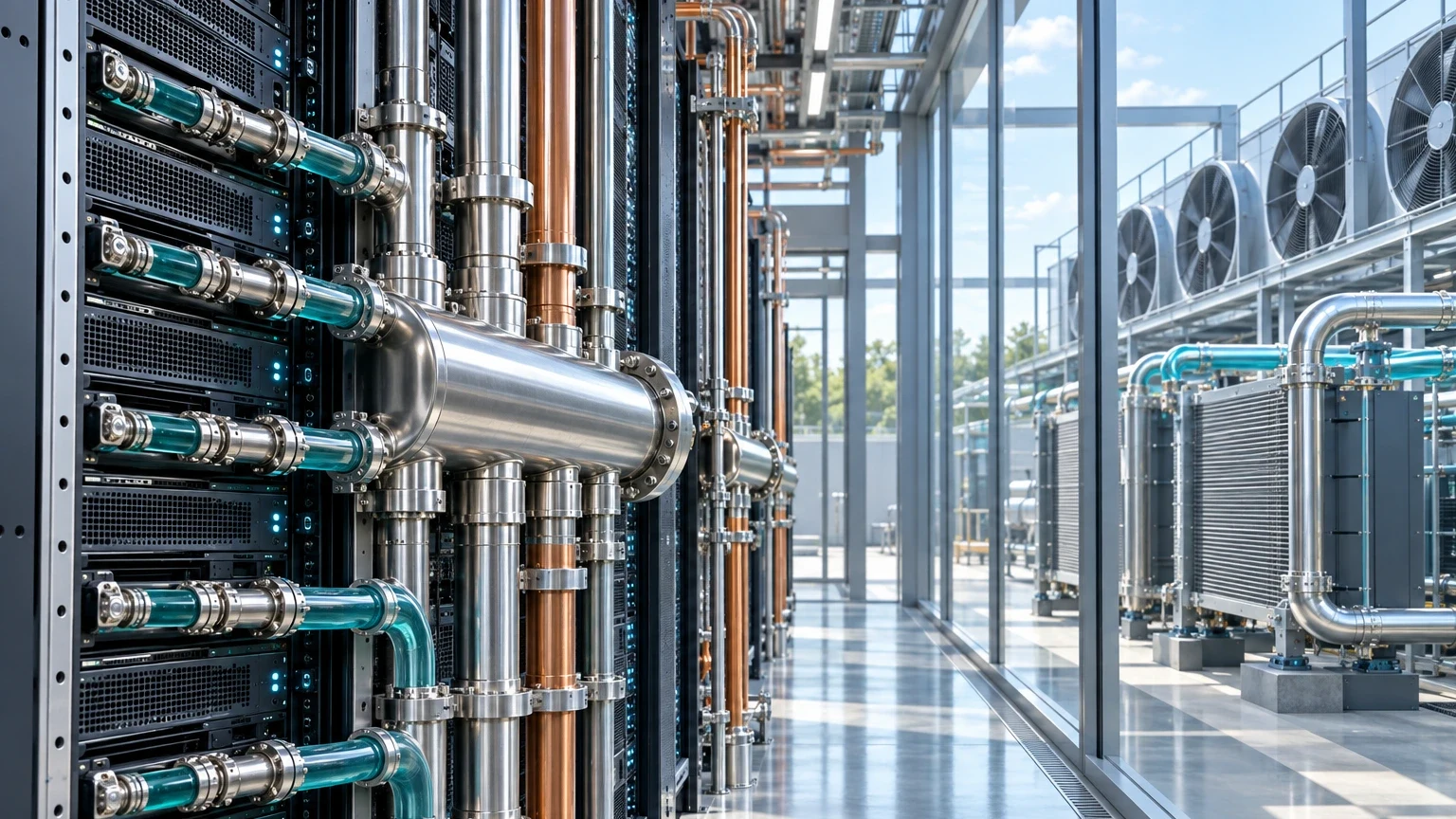
Delta's GoCool-150 liquid-to-air coolant distribution unit, showcased at ASRock Rack's Computex 2026 booth alongside an NVIDIA Rubin Vera NVL72 setup, is a 150kW heat exchanger designed for facilities that do not have a larger liquid-cooling loop integrated into the building, according to ServeTheHome. That phrase — do not have a larger liquid-cooling loop — is the entire story. This is not a product for greenfield builds or next-generation data halls. It is a bridge for operators who built air-cooled infrastructure in the last cycle and now face rack densities they cannot support without tearing out mechanical systems.
I read this as a retrofit admission dressed up as a product launch. The operators who will buy this unit are the ones who cannot wait for facility-wide liquid loops to be designed, permitted, and installed. They have customer commitments or capacity targets that assume racks drawing 200kW will be energized in 2026, and their existing cooling infrastructure cannot keep up. The GoCool-150 lets them swap heat exchangers at the row level without redesigning the building. That is valuable. It is also a signal that cooling has become the binding constraint for a meaningful subset of the market.
ServeTheHome reported that racks drawing 200kW are deployed today, with plans for 600kW-plus racks in the future. Power is arguably the easier problem to solve, the publication noted, thanks to designs such as 800VDC busbars. That leaves cooling as the operational choke point. The operators who built air-cooled halls in 2023 and 2024 now face a choice: wait for greenfield builds with integrated liquid loops, or retrofit existing facilities with row-level CDUs that can handle the thermal load. Delta's product is aimed squarely at the second group.
My thesis is that the winners in the next eighteen months will be the operators who can retrofit cooling capacity faster than competitors can secure permits and energize new builds. Greenfield liquid-loop projects carry long lead times. Mechanical design, local permitting, equipment procurement, and commissioning can stretch twelve to eighteen months even when power interconnection is not the gate. A row-level CDU that ships in volume and installs in weeks turns stranded air-cooled capacity into deployable liquid-cooled capacity without waiting for a new building. If Delta can deliver units on the schedule that matters — late 2026 into early 2027 — then operators with existing power allocations and air-cooled halls will be able to deploy racks drawing 200kW ahead of competitors who are waiting for greenfield projects to energize.
This position rests on two standing views. First, density transitions are underpriced operational risk. Liquid-cooling retrofits move slower than roadmap slides, and the market consistently underestimates the mechanical and permitting work required to upgrade cooling infrastructure in place. Second, the bottleneck migrates. Chips were the constraint in 2023, power became the constraint in 2024 and 2025, and now cooling is emerging as the next layer that sets deployment schedules. The operators who recognize this early and secure retrofit capacity will capture the deployment advantage.
Colo Providers With Power Win the Retrofit Race
The immediate winners are colocation providers and hyperscalers with existing air-cooled facilities and firm power allocations. If you have energized power and cooling infrastructure that cannot support high-density racks, the GoCool-150 turns that into deployable capacity for racks drawing 200kW without waiting for a new substation or a facility redesign. The losers are operators who assumed that greenfield builds would be the only path to high-density deployment and are now locked into eighteen-month timelines while competitors retrofit and deploy in six months.
Delta benefits if it can ship volume units and establish installation track record quickly. The market for retrofit cooling is time-sensitive: operators need units delivered and installed in 2026 to meet 2027 capacity targets. If Delta ships on schedule and installation proves straightforward, it captures a retrofit cycle that may be larger than the market currently prices. If installation is complex or lead times stretch, the advantage evaporates and operators revert to waiting for greenfield projects.
ASRock Rack and NVIDIA gain deployment velocity if the CDU enables faster NVL72 rollouts. The NVL72 is a high-density rack designed for inference and training workloads, and its value proposition depends on operators being able to deploy it at scale. If cooling becomes the constraint that delays deployment, the rack's competitive position weakens. A retrofit path that accelerates deployment protects the product's market position.
The operators who lose are those who overbuilt air-cooled capacity in the last cycle and cannot justify the retrofit cost, or those who committed to greenfield projects before the retrofit option became viable. Stranded cooling capacity is a real cost: if you built for lower-density racks and the market moved to 200kW, you either retrofit or accept lower utilization. The retrofit cost is material — row-level CDUs, piping, controls, and commissioning add up — but it is lower than the opportunity cost of waiting eighteen months for a new build.
Volume Shipments Could Flip the Advantage
The strongest case against my thesis is that Delta ships volume units on schedule and installation proves faster than expected. If the GoCool-150 can be installed in weeks rather than months, and if Delta can supply hundreds of units in late 2026, then the retrofit path could actually accelerate deployment for second-movers who avoided early overbuilding. In that scenario, operators who waited and did not commit to greenfield liquid-loop projects gain an advantage: they retrofit existing facilities quickly and deploy racks drawing 200kW ahead of competitors who are still waiting for new buildings to energize.
This would turn late entry into an advantage rather than a penalty. The operators who built conservatively in 2023 and 2024, avoiding overcommitment to air-cooled infrastructure, would be able to retrofit selectively and deploy high-density racks faster than those who overbuilt. The market has seen this pattern before in other infrastructure transitions: the second-movers who wait for the retrofit path to mature often deploy faster than the first-movers who committed early to a technology that required facility redesign.
If this scenario plays out, the real winners are the operators with the best execution track record on mechanical retrofits, not those with the most greenfield capacity under construction. Installation speed and commissioning quality become the differentiators, and Delta's ability to support rapid deployment becomes the critical variable.