Veeam Expands Data Resilience Portfolio with DataAI Command Platform, v13.1 Updates, and AI Trust Framework:
Capital is moving toward AI infrastructure, but execution risk still decides who captures the demand.
- StorageReview reported a development that could affect hyperscalers & cloud planning.
- The practical issue is whether demand can be converted into reliable capacity on schedule.
- Watch execution details, customer commitments, and any bottlenecks around power, cooling, silicon, or permitting.
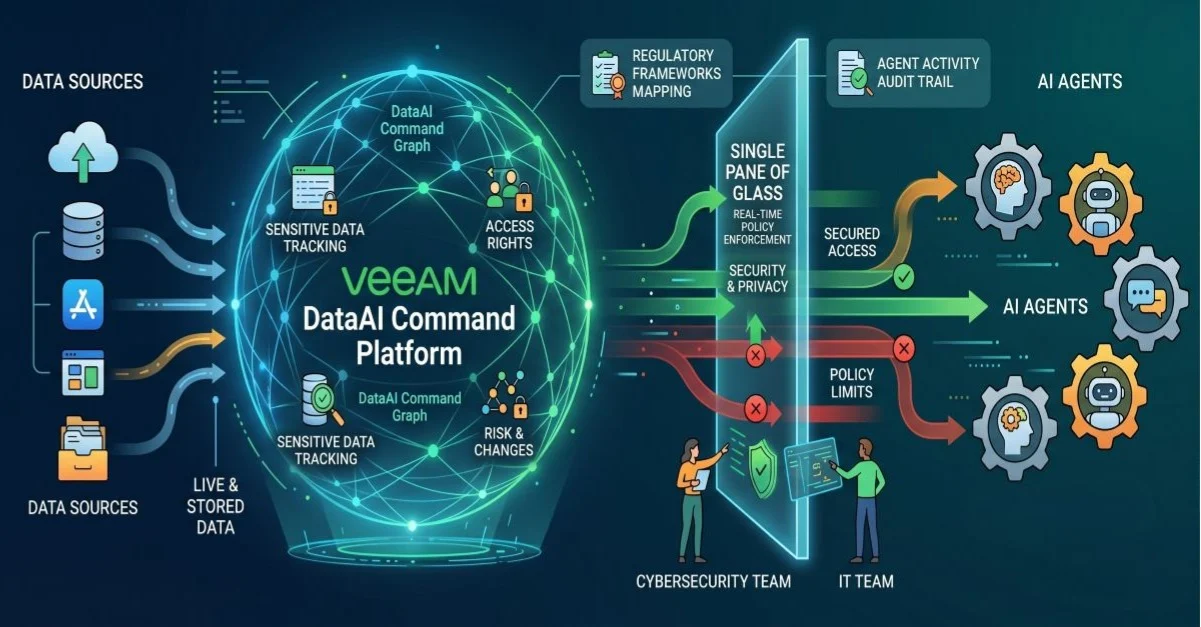
StorageReview reported: At VeeamON 2026 in New York City, Veeam Software introduced a set of coordinated announcements that extend its data resilience strategy into the emerging operational realities of AI. The company unveiled the Veeam DataAI Command Platform, previewed Veeam Data Platform v13.1 alongside a new DataAI Resilience Module, and launched a Data and AI Trust Maturity Model to help enterprises benchmark governance and operational readiness. Together, these updates position Veeam to address a growing gap between the rapid adoption of AI and the ability to secure, govern, and recover the data those systems depend on. The Veeam DataAI Command Platform is a new architectural layer that unifies data protection, security, governance, and compliance for environments where autonomous AI agents operate at scale. The platform builds on Veeam's acquisition of Securiti AI, integrating data security posture management with Veeam's existing resilience stack. At its core is the DataAI Command Graph, an intelligence layer that maps relationships across data, identities, and access controls spanning cloud, SaaS, and on-premises environments. Unlike traditional inventory approaches, the graph operates at a granular level, identifying specific sensitive data elements, access paths, and changes that introduce risk. It also correlates production and backup data, enabling more context-aware recover.
The story lands in a market where demand is already assumed. The more useful question is whether the supporting layer around cloud infrastructure is flexible enough to turn that demand into available capacity. The constraint is capital discipline. AI infrastructure is attracting money, but the gap between committed capital and operating capacity can still be wide when land, power, equipment, and customers do not line up on the same timetable.
The pressure point is timing. Capital formation here should be read as a proxy for who is being trusted to secure future capacity, not only as a balance-sheet event.
Investors will look for signs that funding is tied to real capacity, durable contracts, and credible execution rather than a broad enthusiasm for anything attached to AI demand.
The financial question is whether this improves pricing power, secures scarce capacity, or exposes execution risk that is still being discounted, the operating question is procurement timing, facility readiness, power access, and whether adjacent constraints slow deployment, and the customer question is whether this changes build sequencing, partner dependence, or the cost of scaling clusters across regions.
This is where AI infrastructure differs from ordinary software growth. Capacity has to be financed, permitted, powered, cooled, connected, staffed, and then sold into real workloads before the economics are visible.
The practical read is that infrastructure advantage is becoming more local and more operational. Two companies can chase the same AI demand and end up with very different outcomes if one has better access to power, more credible delivery dates, or a cleaner path through procurement and permitting.
The next signal to watch is customer commitments, infrastructure readiness, and any signs that power, cooling, silicon supply, or permitting becomes the real bottleneck. The next test is whether financing terms, customer commitments, and construction milestones keep moving in the same direction.