When Growth Meets Reality: Why Community Alignment Is Reshaping Data Center Development at ITW 2026: what it
The real test is whether power access can keep pace with AI infrastructure demand.
- Data Center POST reported a development that could affect colocation & wholesale planning.
- The practical issue is whether demand can be converted into reliable capacity on schedule.
- Watch execution details, customer commitments, and any bottlenecks around power, cooling, silicon, or permitting.
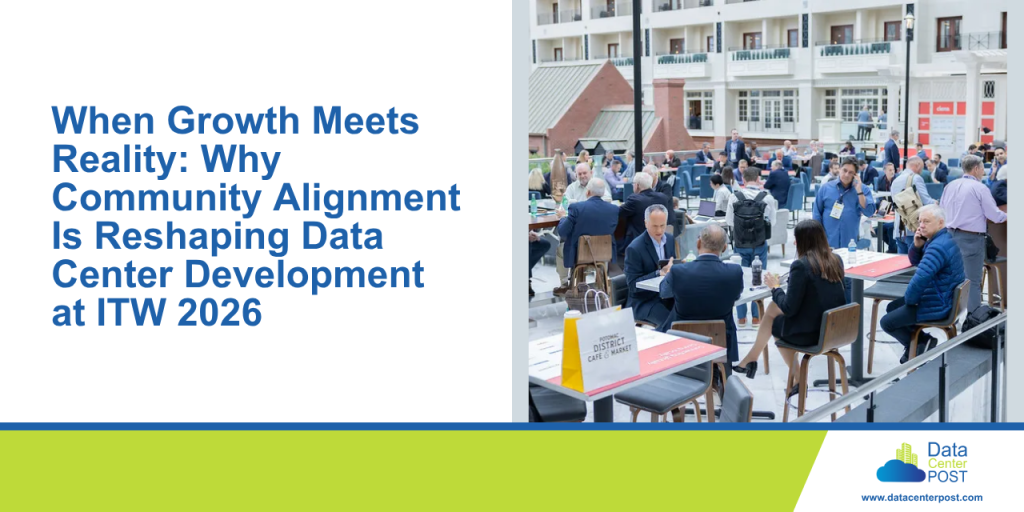
Data Center POST reported: Data center growth is colliding with a new set of realities that extend well beyond land and power. What was once driven by access to land, power, and capital is now increasingly shaped by community alignment. At ITW 2026, this shift will take center stage as industry leaders examine how public perception, policy dynamics, and local engagement are influencing development timelines. As demand accelerates, particularly with AI-driven workloads, developers are encountering new challenges. Projects are being evaluated not only on technical and financial viability, but also on environmental impact, water usage, and long-term community value. Permitting delays and opposition are often tied to uncertainty, reinforcing the need for clearer communication and more transparent planning. A featured session, “Debunking the Data Center Misinformation Dilemma,” will address these issues on May 19, 2026 during the Digital Infrastructure Policy & Investment Summit. The panel will explore how public perception and policy pressures are shaping project timelines and what the industry must do to respond. The discussion includes Ilissa Miller CEO at iMiller Public Relations (iMPR), who also serves on the board of OIX and leads its Digital Infrastructure Framework Committee (DIFC). She will be joined by Buddy Rizer of Loudoun County Department of Economic Development, Joanna Soucy of Aligned Dat.
The important part is what the report says about data center leasing as a working system, not just as a demand story. The constraint is not only the price of electricity. It is the timing of grid access, the flexibility of large loads, and the ability of data center operators to behave less like passive consumers and more like active participants in the power system.
That is the reason the development deserves attention beyond the immediate headline. Power access and interconnection timing are likely to matter more than the announced demand signal itself.
For infrastructure teams, that makes power procurement and site selection part of the product roadmap. A campus can have customers, capital, and equipment lined up and still lose time if the grid connection, market rules, or operating model cannot absorb the load profile.
The financial question is whether this improves pricing power, secures scarce capacity, or exposes execution risk that is still being discounted, the operating question is procurement timing, facility readiness, power access, and whether adjacent constraints slow deployment, and the customer question is whether this changes build sequencing, partner dependence, or the cost of scaling clusters across regions.
There is also a timing issue. In AI infrastructure, announcements often arrive before the hard parts are visible: interconnection queues, equipment lead times, operating approvals, financing conditions, and the practical work of matching customer demand to physical capacity.
For readers tracking this market, the useful lens is less about whether demand exists and more about where it can be served without delay. A small operational change can matter if it gives operators more flexibility, improves utilization, or exposes a bottleneck that had been hidden inside a broader growth story.
The next signal to watch is customer commitments, infrastructure readiness, and any signs that power, cooling, silicon supply, or permitting becomes the real bottleneck. The next test is whether this remains a narrow market experiment or becomes a normal tool for balancing AI demand with grid reliability.